This is default featured slide 1 title

Go to Blogger edit html and find these sentences.Now replace these sentences with your own descriptions.This theme is Bloggerized by Lasantha Bandara - Premiumbloggertemplates.com.

This is default featured slide 2 title

Go to Blogger edit html and find these sentences.Now replace these sentences with your own descriptions.This theme is Bloggerized by Lasantha Bandara - Premiumbloggertemplates.com.

This is default featured slide 3 title

Go to Blogger edit html and find these sentences.Now replace these sentences with your own descriptions.This theme is Bloggerized by Lasantha Bandara - Premiumbloggertemplates.com.

This is default featured slide 4 title

Go to Blogger edit html and find these sentences.Now replace these sentences with your own descriptions.This theme is Bloggerized by Lasantha Bandara - Premiumbloggertemplates.com.

This is default featured slide 5 title

Go to Blogger edit html and find these sentences.Now replace these sentences with your own descriptions.This theme is Bloggerized by Lasantha Bandara - Premiumbloggertemplates.com.

Rabu, 12 Juni 2013

Ebook Molecular Pharmacology: From DNA to Drug Discovery

Ebook Molecular Pharmacology: From DNA to Drug Discovery

Find tons of guide brochures in this site as the option of you seeing this web page. You can additionally sign up with to the web site book collection that will reveal you many publications from any kind of types. Literature, scientific research, national politics, and much more catalogues exist to offer you the most effective publication to discover. The book that actually makes you really feels completely satisfied. Or that's guide that will save you from your task due date.
Molecular Pharmacology: From DNA to Drug Discovery

Molecular Pharmacology: From DNA to Drug Discovery


Molecular Pharmacology: From DNA to Drug Discovery


Ebook Molecular Pharmacology: From DNA to Drug Discovery

Molecular Pharmacology: From DNA To Drug Discovery. Exactly what are you doing when having downtime? Talking or browsing? Why do not you aim to check out some e-book? Why should be reviewing? Checking out is among fun and also satisfying task to do in your leisure. By checking out from many sources, you can find new details and experience. The publications Molecular Pharmacology: From DNA To Drug Discovery to check out will be many beginning with scientific e-books to the fiction e-books. It means that you can check out guides based upon the requirement that you intend to take. Certainly, it will be various as well as you can check out all e-book kinds whenever. As below, we will certainly show you a book ought to be checked out. This book Molecular Pharmacology: From DNA To Drug Discovery is the selection.

Keep your method to be below as well as read this resource finished. You can appreciate browsing guide Molecular Pharmacology: From DNA To Drug Discovery that you truly refer to obtain. Below, obtaining the soft documents of the book Molecular Pharmacology: From DNA To Drug Discovery can be done easily by downloading in the link page that we give right here. Of course, the Molecular Pharmacology: From DNA To Drug Discovery will be all yours faster. It's no should get ready for guide Molecular Pharmacology: From DNA To Drug Discovery to get some days later on after acquiring. It's no have to go outside under the warms at mid day to visit guide store.

It won't take more time to purchase this Molecular Pharmacology: From DNA To Drug Discovery It will not take more cash to print this e-book Molecular Pharmacology: From DNA To Drug Discovery Nowadays, people have been so smart to make use of the modern technology. Why don't you utilize your device or other gadget to save this downloaded soft file book Molecular Pharmacology: From DNA To Drug Discovery Through this will let you to consistently be come with by this e-book Molecular Pharmacology: From DNA To Drug Discovery Naturally, it will be the most effective close friend if you read this e-book Molecular Pharmacology: From DNA To Drug Discovery up until finished.

To deal with this condition, many other people also try to get this book as their reading now. Are you interested? Pick this best book to offer today, we offer this book for you because it’s a kind of amazing book from professional and experienced author. Becoming the good friend in your lonely without giving boredom is the characteristic of Molecular Pharmacology: From DNA To Drug Discovery that we present in this website.

Molecular Pharmacology: From DNA to Drug Discovery

Review

“Overall, it could be the basis of an excellent course for junior pharmacologists in basic science research who need a greater focus on the mechanisms of drug action rather than an encyclopedic survey of clinical drug use.”  (Doody’s, 26 July 2013)

Read more

From the Back Cover

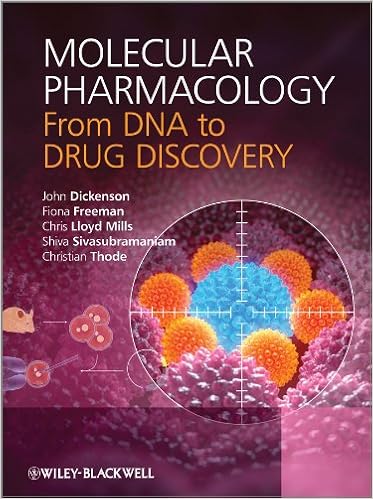
This textbook provides a fresh, comprehensive and accessible introduction to the rapidly expanding field of molecular pharmacology. Adopting a drug target-based, rather than the traditional organ/system based, approach this innovative guide reflects the current advances and research trend towards molecular based drug design, derived from a detailed understanding of chemical responses in the body. Drugs are then tailored to fit a treatment profile, rather than the traditional method of ‘trial and error’ drug discovery which focuses on testing chemicals on animals or cell cultures and matching their effects to treatments. Providing an invaluable resource for advanced under-graduate and MSc/PhD students, new researchers to the field and practitioners for continuing professional development, Molecular Pharmacology explores; recent advances and developments in the four major human drug target families (G-protein coupled receptors, ion channels, nuclear receptors and transporters), cloning of drug targets, transgenic animal technology, gene therapy, pharmacogenomics and looks at the role of calcium in the cell. Current - focuses on cutting edge techniques and approaches, including new methods to quantify biological activities in different systems and ways to interpret and understand pharmacological data. Cutting Edge - highlights advances in pharmacogenomics and explores how an individual’s genetic makeup influences their response to therapeutic drugs and the potential for harmful side effects. Applied - includes numerous, real-world examples and a detailed case-study based chapter which looks at current and possible future treatment strategies for cystic fibrosis. This case study considers the relative merits of both drug therapy for specific classes of mutation and gene therapy to correct the underlying defect. Accessible - contains a comprehensive glossary, suggestions for further reading at the end of each chapter and an associated website that provides a complete set of figures from within the book. A companion website with additional resources is available at www.wiley.com/go/dickenson/dnamolecular

Read more

See all Editorial Reviews

Product details

Paperback: 424 pages

Publisher: Wiley-Blackwell; 1 edition (January 22, 2013)

Language: English

ISBN-10: 0470684437

ISBN-13: 978-0470684436

Product Dimensions:

7.5 x 0.8 x 9.7 inches

Shipping Weight: 2 pounds (View shipping rates and policies)

Average Customer Review:

Be the first to review this item

Amazon Best Sellers Rank:

#3,378,205 in Books (See Top 100 in Books)

Molecular Pharmacology: From DNA to Drug Discovery PDF
Molecular Pharmacology: From DNA to Drug Discovery EPub
Molecular Pharmacology: From DNA to Drug Discovery Doc
Molecular Pharmacology: From DNA to Drug Discovery iBooks
Molecular Pharmacology: From DNA to Drug Discovery rtf
Molecular Pharmacology: From DNA to Drug Discovery Mobipocket
Molecular Pharmacology: From DNA to Drug Discovery Kindle

Molecular Pharmacology: From DNA to Drug Discovery PDF

Molecular Pharmacology: From DNA to Drug Discovery PDF

Molecular Pharmacology: From DNA to Drug Discovery PDF

PDF Ebook , by John D. Rockefeller

PDF Ebook , by John D. Rockefeller

This book , By John D. Rockefeller deals you better of life that could produce the top quality of the life brighter. This , By John D. Rockefeller is exactly what individuals currently require. You are right here as well as you could be precise and certain to get this book , By John D. Rockefeller Never ever question to get it also this is just a publication. You can get this publication , By John D. Rockefeller as one of your collections. However, not the compilation to display in your bookshelves. This is a valuable publication to be checking out compilation.

, by John D. Rockefeller

, by John D. Rockefeller


, by John D. Rockefeller


PDF Ebook , by John D. Rockefeller

After couple of time, finally guide that we as well as you wait on is coming. So alleviated to get this fantastic publication readily available to present in this web site. This is the book, the DDD. If you still feel so tough to obtain the printed publication in the book store, you can accompany us again. If you have actually ever got guide in soft data from this book, you could easily get it as the recommendation now.

The , By John D. Rockefeller is guide that we currently advise. This is not type of huge publication. However, this book will certainly aid you to reach the big idea. When you involve read this book, you could obtain the soft file of it and save it in some numerous devices. Obviously, it will certainly depend upon exactly what tool that you possess as well as do. For this instance, the book is advised to conserve in laptop, computer, or in the device.

This publication will certainly be constantly most desired due to the fact that the subject to increase is popular. Besides, it includes the topic for every single age and also condition. All degrees of people rate effectively to read this book. The development of this book is that you may not should really feel tough to recognize just what this book offer. The lesson, knowledge, experience, as well as all things that could supply will need your life time to really feel much better.

As soon as much more, checking out practice will certainly always give beneficial advantages for you. You could not have to spend many times to read guide , By John D. Rockefeller Simply established aside several times in our spare or spare times while having meal or in your workplace to check out. This , By John D. Rockefeller will certainly show you brand-new point that you can do now. It will certainly help you to improve the quality of your life. Occasion it is just a fun publication , By John D. Rockefeller, you could be happier and more fun to take pleasure in reading.

, by John D. Rockefeller

Product details

File Size: 1257 KB

Print Length: 128 pages

Publisher: Skyhorse (March 31, 2015)

Publication Date: March 31, 2015

Sold by: Amazon Digital Services LLC

Language: English

ASIN: B00USBMFZE

Text-to-Speech:

Enabled

P.when("jQuery", "a-popover", "ready").execute(function ($, popover) {

var $ttsPopover = $('#ttsPop');

popover.create($ttsPopover, {

"closeButton": "false",

"position": "triggerBottom",

"width": "256",

"popoverLabel": "Text-to-Speech Popover",

"closeButtonLabel": "Text-to-Speech Close Popover",

"content": '

' + "Text-to-Speech is available for the Kindle Fire HDX, Kindle Fire HD, Kindle Fire, Kindle Touch, Kindle Keyboard, Kindle (2nd generation), Kindle DX, Amazon Echo, Amazon Tap, and Echo Dot." + '
'

});

});

X-Ray:

Not Enabled

P.when("jQuery", "a-popover", "ready").execute(function ($, popover) {

var $xrayPopover = $('#xrayPop_BBD5E60852BA11E9A2A3049E7576A912');

popover.create($xrayPopover, {

"closeButton": "false",

"position": "triggerBottom",

"width": "256",

"popoverLabel": "X-Ray Popover ",

"closeButtonLabel": "X-Ray Close Popover",

"content": '

' + "X-Ray is not available for this item" + '
',

});

});

Word Wise: Enabled

Lending: Not Enabled

Screen Reader:

Supported

P.when("jQuery", "a-popover", "ready").execute(function ($, popover) {

var $screenReaderPopover = $('#screenReaderPopover');

popover.create($screenReaderPopover, {

"position": "triggerBottom",

"width": "500",

"content": '

' + "The text of this e-book can be read by popular screen readers. Descriptive text for images (known as “ALT text”) can be read using the Kindle for PC app and on Fire OS devices if the publisher has included it. If this e-book contains other types of non-text content (for example, some charts and math equations), that content will not currently be read by screen readers. Learn more" + '
',

"popoverLabel": "The text of this e-book can be read by popular screen readers. Descriptive text for images (known as “ALT text”) can be read using the Kindle for PC app if the publisher has included it. If this e-book contains other types of non-text content (for example, some charts and math equations), that content will not currently be read by screen readers.",

"closeButtonLabel": "Screen Reader Close Popover"

});

});

Enhanced Typesetting:

Enabled

P.when("jQuery", "a-popover", "ready").execute(function ($, popover) {

var $typesettingPopover = $('#typesettingPopover');

popover.create($typesettingPopover, {

"position": "triggerBottom",

"width": "256",

"content": '

' + "Enhanced typesetting improvements offer faster reading with less eye strain and beautiful page layouts, even at larger font sizes. Learn More" + '
',

"popoverLabel": "Enhanced Typesetting Popover",

"closeButtonLabel": "Enhanced Typesetting Close Popover"

});

});

Amazon Best Sellers Rank:

#483,985 Paid in Kindle Store (See Top 100 Paid in Kindle Store)

This was very good but not great. The business insights were still strong in many areas of our work today so it made the old saying ring true again; "Everything is different but everything remains the same." I purchased this book on sale and was worth the small investment. The ending however, came out of nowhere. I think it is worth the read but I would recommend doing a Wikipedia or similar search on JDR to read a little deeper into his thinking and to see how he addresses what many would believe to be hypocritical in some instances.

Full of challenging quotes; three follow:“Good management consists of showing average people how to do the work of superior people.”“... It is one thing to stand on the comfortable ground of placid inaction and put forth words of cynical wisdom, and another to plunge into the work itself and through strenuous experience earn the right to express strong conclusions.”“I believe in the dignity of labor, whether with head or hand; that the world owes no man a living but that it owes every man an opportunity to make a living.”

The book contained some interesting quotes and insights from Rockefeller about how he does business and his personal life. My favorite sections were the letters between him and his son and daughter; there was a lot of insight about the relationships he had with them. The book was quite short, however. You can check the dimensions for the size, but in between quotes there was a descent amount of space, making the book a very quick read. But it was overall an interesting book to read.

Literally a collection of his quotes and not organized too well. But if you are interested in how John D thought and would like to reference his quotes this is a nice reference.

This is a great collection of quotations from John D. Rockefeller on a variety of subjects related to money. A very easy read, and very interesting, especially the personal letters at the end of the book between himself and his son. I enjoyed it, but didn't get any revolutionary information from it.

Titan is a much better look into Rockefeller's views, but this book is a helpful collection of his writings.

Quick, easy read about one of the greatest businessmen to have ever lived. Lots of takeaways in this little book. Perfect for anyone in business or wanting to go into business.

Some good quotes but I just get a whole lot out of the book. Quick read but I was expecting more.

, by John D. Rockefeller PDF
, by John D. Rockefeller EPub
, by John D. Rockefeller Doc
, by John D. Rockefeller iBooks
, by John D. Rockefeller rtf
, by John D. Rockefeller Mobipocket
, by John D. Rockefeller Kindle

, by John D. Rockefeller PDF

, by John D. Rockefeller PDF

, by John D. Rockefeller PDF

Senin, 10 Juni 2013

Free Ebook Pattern Recognition

Free Ebook Pattern Recognition

Checking out will make straightforward means and it's not limited enough to do. You will certainly have recent book to read in fact, yet if you feel tired of it you can continue to obtain the Pattern Recognition From the Pattern Recognition, we will certainly continue to supply you the most effective book collection. When the book is read in the spare time, you can take pleasure in exactly how exactly this publication is for. Yeah, while someone intend to get ease of reviewing some publications, you have located it.

Pattern Recognition

Pattern Recognition


Pattern Recognition


Free Ebook Pattern Recognition

What's your necessity to be reviewing product in this time? Is that the book that belongs to the duties? Is that guide that can entertain you in your lonesome time? Or, is that only sort of publication that you can read to accompany the spare time? Everyone has different reason that they choose the specific publication. It will feature certain cover design, fascinating title, recommended subject, required style, and specialist authors.

Reading is not for other people that obligate or order you to check out. The one that can enjoy and also utilize the benefits of reading is you. So, it is not kind of even worse when you are trying to be better by analysis. Even reading will not lead you to be successful 100%; this way can help you to fulfil the condition, lesson, experience, and knowledge. In addition, this book entitled Pattern Recognition likewise turns into one that is actually prominent.

No, we will certainly share you some motivations regarding just how this Pattern Recognition is referred. As one of the analysis book, it's clear that this book will be absolutely performed substantially. The related topic as you need now comes to be the man element why you should take this publication. In addition, getting this book as one of reading products will certainly improve you to obtain more information. As known, more info you will get, much more updated you will certainly be.

For more interesting reason, you may unknown concerning the content of this publication, may you? Why do not you aim to recognize? Comprehending new point will lead to conceptualize the life better. You might not only check out as the tasks, but reading can be a means to earn your life run well. By this Pattern Recognition you can truly think of exactly how the life will be as well as need to be.

Pattern Recognition

Review

"This book is an excellent reference for pattern recognition, machine learning, and data mining. It focuses on the problems of classification and clustering, the two most important general problems in these areas. This book has tremendous breadth and depth in its coverage of these topics; it is clearly the best book available on the topic today. The new edition is an excellent up-to-date revision of the book. I have especially enjoyed the new coverage provided in several topics, including new viewpoints on Support Vector Machines, and the complete in-depth coverage of new clustering methods. This is a standout characteristic of this book: the coverage of the topics is solid, deep, and principled throughout. The book is very successful in bringing out the important points in each technique, while containing lots of interesting examples to explain complicated concepts. I believe the section on dimensionality reduction is an excellent exposition on this topic, among the best available, and this is just one example. Combined with a coverage unique in its extend, this makes the book appropriate for use as a reference, as a textbook for upper level undergraduate or graduate classes, and for the practitioner that wants to apply these techniques in practice. I am a professor in Computer Science. Although pattern recognition is not my main focus, I work in the related fields of data mining and databases. I have used this book for my own research and, very successfully, as teaching material. I would strongly recommend this book to both the academic student and the professional."Â --Dimitrios Gunopoulos, University of California, Riverside, USA "I cut my pattern recognition teeth on a draft version of Duda and Hart (1973). Over subsequent decades, I consistently did two things: (i) recommended Duda and Hart as the best book available on pattern recognition; and (ii) wanted to write the next best book on this topic.nbsp; I stopped (i) when the first edition ofnbsp;S. Theodoridis andnbsp;K. Koutroumbas'nbsp;book appeared, and it supplanted the need for (ii) It was, and is, the best book that has been written on the subject since Duda and Hart's seminal original text. Buy it - you'll be happy you did." --Jim Bezdek, University of West Florida and Senior Fellow, U. of Melbourne (Australia) "I consider the fourth edition of the book Pattern Recognition, by S. Theodoridis and K. Koutroumbas as the Bible of Pattern Recognition." --Simon Haykin, McMaster University, Canada "I have taught a graduate course on statistical pattern recognition for more than twenty five years during which I have used many books with different levels of satisfaction. Recently, I adopted the book by Theodoridis and Koutroumbas (4th edition) for my graduate course on statistical pattern recognition at University of Maryland. This course is taken by students from electrical engineering, computer science, linguistics and applied mathematics. The comprehensive book by Thedoridis and Koutroumbas covers both traditional and modern topics in statistical pattern recognition in a lucid manner, without compromising rigor. This book elegantly addresses the needs of graduate students from the different disciplines mentioned above. This is the only book that does justice to both supervised and unsupervised (clustering) techniques. Every student, researcher and instructor who is interested in any and all aspects of statistical pattern recognition will find this book extremely satisfying. I recommend it very highly." --Rama Chellappa, University of Maryland "The book Pattern Recognition, by Profs. Sergios Theodoridis and Konstantinos Koutroumbas, has rapidly become the ""bible"" for teaching and learning the ins and outs of pattern recognition technology.nbsp; In my own teaching, I have utilized the material in the first four chapters of the book (from basics to Bayes Decision Theory to Linear Classifiers and finally to Nonlinear Classifiers) in my class on fundamentals of speech recognition and have found the material to be presented in a clear and easily understandable manner, with excellent problems and ideas for projects.nbsp; My students have all learned the basics of pattern recognition from this book and I highly recommend it to any serious student in this area." --Prof. Lawrence Rabiner

Read more

About the Author

Sergios Theodoridis is Professor of Signal Processing and Machine Learning in the Department of Informatics and Telecommunications of the University of Athens. He is the co-author of the bestselling book, Pattern Recognition, and the co-author of Introduction to Pattern Recognition: A MATLAB Approach. He serves as Editor-in-Chief for the IEEE Transactions on Signal Processing, and he is the co-Editor in Chief with Rama Chellapa for the Academic Press Library in Signal Processing. He has received a number of awards including the 2014 IEEE Signal Processing Magazine Best Paper Award, the 2009 IEEE Computational Intelligence Society Transactions on Neural Networks Outstanding Paper Award, the 2014 IEEE Signal Processing Society Education Award, the EURASIP 2014 Meritorious Service Award, and he has served as a Distinguished Lecturer for the IEEE Signal Processing Society and the IEEE Circuits and Systems Society. He is a Fellow of EURASIP and a Fellow of IEEE.Konstantinos Koutroumbas acquired a degree from the University of Patras, Greece in Computer Engineering and Informatics in 1989, a MSc in Computer Science from the University of London, UK in 1990, and a Ph.D. degree from the University of Athens in 1995. Since 2001 he has been with the Institute for Space Applications and Remote Sensing of the National Observatory of Athens.Konstantinos Koutroumbas acquired a degree from the University of Patras, Greece in Computer Engineering and Informatics in 1989, a MSc in Computer Science from the University of London, UK in 1990, and a Ph.D. degree from the University of Athens in 1995. Since 2001 he has been with the Institute for Space Applications and Remote Sensing of the National Observatory of Athens.

Read more

Product details

Hardcover: 984 pages

Publisher: Academic Press; 4 edition (November 3, 2008)

Language: English

ISBN-10: 1597492728

ISBN-13: 978-1597492720

Product Dimensions:

7.6 x 2 x 9.3 inches

Shipping Weight: 3.7 pounds (View shipping rates and policies)

Average Customer Review:

4.0 out of 5 stars

30 customer reviews

Amazon Best Sellers Rank:

#977,714 in Books (See Top 100 in Books)

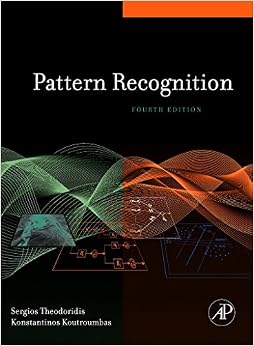
Many who work in artificial intelligence have commented that it is the ability of the human brain to engage in pattern recognition that gives it true intelligence. Without a quantitative measure of machine intelligence it is difficult to assess this claim, but there is no doubt that being able to implement pattern recognition and classification in a machine in a manner that enables it to distinguish objects, find profitable patterns in financial time series, teach itself how to play a game by examining the moves, identify subsequences in genome data, identify malicious behavior in networks, and detect fraudulent behavior in mortgage contracts would be a major advance in artificial intelligence and also a profitable one from a financial standpoint. Even if the machine required assistance from a human to do these tasks it would still be very useful. If it were able to do them on its own without any supervision one could justifiably describe it as being more intelligent than one that required such supervision (the counterexample to this imputation of intelligence is simple trial-and-error, which of course is unsupervised).This book is a formal treatment of pattern recognition that is geared to a readership with a strong mathematical background and which makes as its major theme the difference between `supervised' and `unsupervised' pattern recognition, with this difference sometimes being more qualitative than what one would like. In the introduction to the book the authors make clear the distinction between these approaches, motivate the problem of the classification of features, and outline briefly the stages in the design of a pattern classification system. As is well known, supervised pattern recognition involves the use of training data, whereas unsupervised pattern recognition does not. In the latter case, it is left to the machine to find similarities in the feature vectors, and then cluster the similar feature vectors together. Researchers in the field of pattern recognition have devised an enormous number of algorithms and reasoning patterns to perform both unsupervised and supervised learning, and they have not necessarily developed these approaches in the context of machine intelligence. Thus the book could also be viewed as a mathematical theory of pattern recognition instead of one that is embedded in the field of artificial intelligence. However it is classified it is a useful and important work, and is well worth the time taken to read and study.One of the most interesting (and esoteric) discussions is found in chapter 15 of the book. One of these concerns algorithms for `competitive learning' wherein representatives are designated and then "compete" with each other after a feature vector X is presented to the algorithm. The "winner" is the representative that is closer to X and the representatives are then updated by moving the winner toward X, with the rest remaining constant or move toward X at a slower rate. The competitive learning algorithm is parametrized by the learning rates of the winner and the losers, and the losers can have different learning rates. The investigator however selects the values of these parameters beforehand, and therefore competitive learning strictly speaking should not be classified as totally unsupervised. To be really unsupervised the competitive learning algorithm would have to make the selection of these parameters and tune them as needed to reach the convergence criterion. The authors do discuss briefly a version of the algorithm where the learning rate is variable, but the rate is still subject to certain constraints. Chapter 15 also contains a brief discussion of the use of genetic algorithms in clustering.Another topic in the book that is both interesting and important and is still surprisingly unknown by many is that of `independent component analysis'. Independent component analysis (ICA) is a generalization of principal component analysis in that it tries to find a transformation that takes a feature vector into one whose components are mutually independent, instead of merely decorrelated. All of the random variables must be non-Gaussian in order for this technique to work, since the Gaussian case gives back the usual principal component analysis. Independent component analysis is beginning to be applied to many different areas, including finance, risk management, medical imaging, and physics. It remains to see whether it will become a standardized tool in the many mathematical and statistical software packages that exist at the present time. The authors discuss two different ways to perform independent component analysis, one being an approach based on higher order cumulants, and the other, interestingly, on mutual information. In the latter approach, the mutual information between the transformed components is calculated to be the Kullback-Leibler probability distance between the joint probability distribution of the transformed components and the product of the marginal probability densities. This distance is of course zero if the components are statistically independent. The strategy is then to find the transformational matrix that minimizes the mutual information, since this will make the components maximally independent. As the authors point out, the problem with this approach is that the elements of the transformation matrix are hidden in the marginal probability distribution functions of the transformed variables. They then outline an approach that allows them to calculate the mutual information with the assumption that the transformation matrix is unitary.

The book "Pattern Recognition" of Theodoridis and Koutroumbas is an excellent one.It covers the field thoroughly, and the material is presented very clearly, bothfrom the mathematical and the algorithm point of view.It includes superb examples andcomputer experiments with which the reader can gain insight to the topics.Also, it is updated with a lot of recent advances on the Pattern Recognition domain,as e.g. Semi-supervised learning, combining classifiers, spectral clustering,nonlinear dimensionality reduction. The presentation of all these advanced material isvery well organized and the reader can follow and understand thesesophisticated mathematically concepts.It is one of my three best books on the topic,the other ones are the "Neural Networks" of S. Haykin, and "Pattern Recognition and Machine Learning",of C. Bishop.I think all these three books are excellent,in their own way,and should not be missed from the bookshelf of anyone that copes with the Pattern Recognition field,either student or researcher.However, for the reader interested in developing computer algorithms in the Pattern Recognition area,the book of Theodoridis and Koutroubas is the superior choice.

***This is not a review on the book itself, but rather the KINDLE EDITION.***As a person who bought this book as text for a graduate class, it was very hard to distinguish some of the letters in the formulas contained within. Also, some characters don't seem to have been translated properly. Especially misleading was when a subscript was rendered within the kindle cloud reader as a superscript... which gives any equation an entirely different meaning when such a thing is done.I do not recommend purchasing the Kindle edition of this textbook... stick with good old paper until this gets revised.

Although there is a TON of info in this book it's really not that great for learning pattern recognition. It's definitely more of a reference than anything else. You can't really read a section and then sit down at your computer and code it up. There a so many details missing. And the equations are so compact that you spend most your time decoding bad notation. If this book were a piece of software it would suffer from feature bloat. If you need to actually do any real applications using the techniques in this book you should definitely by the MATLAB companion text.

The book describes the field, including classification and clustering, clearly and concisely, while not ignoring the key mathematical concepts. I'm a CS grad student studying this area and have been subjected to a number of textbooks that are math-heavy and fail to give any descriptive context of what's being presented. A good textbook on a subject should actually TEACH the reader the concepts. This one does that quite well. In addition, three chapters on feature generation and processing are included, a subject most other texts barely cover at all. This revised addition is a substantial expansion of the previous one and now includes many recently-developed concepts. If I were teaching an advanced undergrad or graduate course on the subject I would probably choose this as my primary text.

Man, this IS the book on pattern recognition! Lengthy, simple, direct, clean; contains the most essential one must know about all the techniques when working with pattern recognition. I have also Duda et al Pattern Classification. But THIS one is far better and far didactic. If you want to learn how to classify patterns, this is THE book.

Awesome book! I really love it. Mathematics in this books are pretty easy, and the exposition of each topic is magnificent. Also it gives a lot of references which are useful for the practicant and the researcher.

Pattern Recognition PDF
Pattern Recognition EPub
Pattern Recognition Doc
Pattern Recognition iBooks
Pattern Recognition rtf
Pattern Recognition Mobipocket
Pattern Recognition Kindle

Pattern Recognition PDF

Pattern Recognition PDF

Pattern Recognition PDF